Pairing teachers to co-lead small advisory groups that remain with students throughout high school, while also connecting the groups to a dedicated school counselor and assistant principal, helps support students academically, socially, and emotionally, according to contributors Alicia J. Linsey and Robert Michaud.
July 20, 2026
 DGLIMAGES/STOCK.ADOBE.COM
Rethinking Advisory: Teaching SEL in Teams
At Andover High School in Andover, Massachusetts, we’ve been reimagining what it means for students to feel truly connected to school. Like many schools, we recognize the power of strong relationships and the importance of every student having a trusted adult they can turn to. But rather than going with the traditional, top-down model of advisory—where one teacher guides a group of students in isolation—we designed something different. Something more personal, more collaborative, and ultimately, more impactful.
So we tried something new: pairing teachers together to co-lead advisory groups. This small change not only created a richer experience for students but also transformed the way we, as educators, work together. It became an avenue to promote our students’ growth in a much more collaborative way.
How Our Advisory Model Works
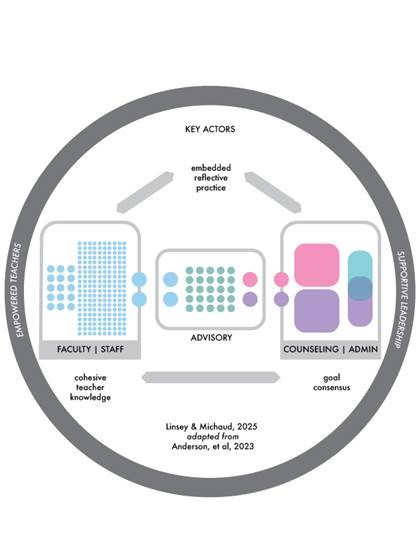
Our advisory is structured around cohorts of 24 students and two co-advisors who ideally stay with those students throughout all four years of high school. That continuity builds trust. Each advisory is connected to a dedicated school counselor and assistant principal. This team structure helps ensure that students are supported from all angles—academic, social, and emotional. The collaboration between teacher partners brings a sense of teamwork that students can feel and benefit from every day.
Our advisory curriculum is designed and continuously updated by a team of teachers we call the Advisory Team. These educators meet regularly to reflect on what’s working, revise lessons, and plan ahead for upcoming activities and curricular goals. Their leadership ensures that the curriculum evolves with our students’ needs and can flexibly adapt to the needs of our school community throughout the year.
Why This Model Works: The Power of Collective Teacher Efficacy
We didn’t just stumble onto this model—we built it with purpose. One of the guiding ideas behind our work is collective teacher efficacy (CTE)—the belief that when educators work together with shared purpose and mutual trust, they can make a real difference in student achievement.
We’ve seen the benefits firsthand. When teachers are empowered to co-lead advisory, when they’re involved in shaping the curriculum, and when they work side by side with counselors and administrators, something powerful happens. Ideas are shared. Challenges are tackled together. Teachers grew in their efficacy beliefs about one another, and our students reaped the benefits.
Our structure has built in all the right conditions for CTE to thrive: shared goals, supportive leadership, regular reflection, and strong communication. Researchers have pointed out the importance of these factors in helping to grow CTE, and our model creates opportunities for all of those key factors to happen. Engaging teachers to work collaboratively in the teaching of social-emotional learning (SEL) is a powerful way to enable them to lead together as they help our students.
Building a Culture of Shared Leadership
The curriculum, grounded in the CASEL framework for SEL, grows with students year by year. It also undergoes revision from our Advisory Team members, who meet regularly throughout the school year to design and implement new curricular ideas. These sessions aren’t just logistics; they are rich opportunities for professional learning, where insights can be shared and lessons adapted based on real-time feedback.
Learning from Our Own Practice
We wanted to make sure our observations weren’t just anecdotal, so we conducted action research to understand the impact of our advisory model better. Grounded in social constructivism—a belief that learning happens through collaboration and shared experience—we looked at how our structure supports both students and faculty. We surveyed faculty on their experience, and the results affirmed what we see every day: When teachers are empowered to lead, and when they work together toward shared goals, students benefit. They feel seen, supported, and more engaged. Teachers, in turn, feel more connected to one another and to the work. Faculty report they feel very high levels of CTE, with particular regard to the level of support they feel from their partners as they work with students. Having teachers feel that way about themselves and their partner’s ability to impact the student experience has given us a great deal to reflect upon as we look to improve our model in the coming years.
What This Means for Other Schools
We believe our model holds promise not just for our school, but for others looking to deepen student relationships and foster a culture of collaboration. Pairing teachers in advisory roles and involving them in curriculum development creates the conditions for collective efficacy to thrive. It empowers teachers, strengthens community, and centers students in everything we do.
Education is about shared responsibility, mutual growth, and the belief that together we can do more for our students than any of us could do alone. We’ve seen how powerful advisory can be when it’s built around collaboration. And we’ve seen the impact of trusting teachers to lead. Our advisory model has helped us create a more connected school community, with a strong sense of collective teacher efficacy. It has helped us make tremendous strides toward making teachers feel valued, students feel supported, and everyone feel that they belong.
Alicia J. Linsey, M.A. (alicia.linsey@andoverma.us), is an assistant principal, and Robert Michaud, Ed.D. (robert.michaud@andoverma.us), is a history teacher for Andover Public Schools, Andover, Massachusetts.